

Are you ready to meet your next level? Click here to book your free discovery call
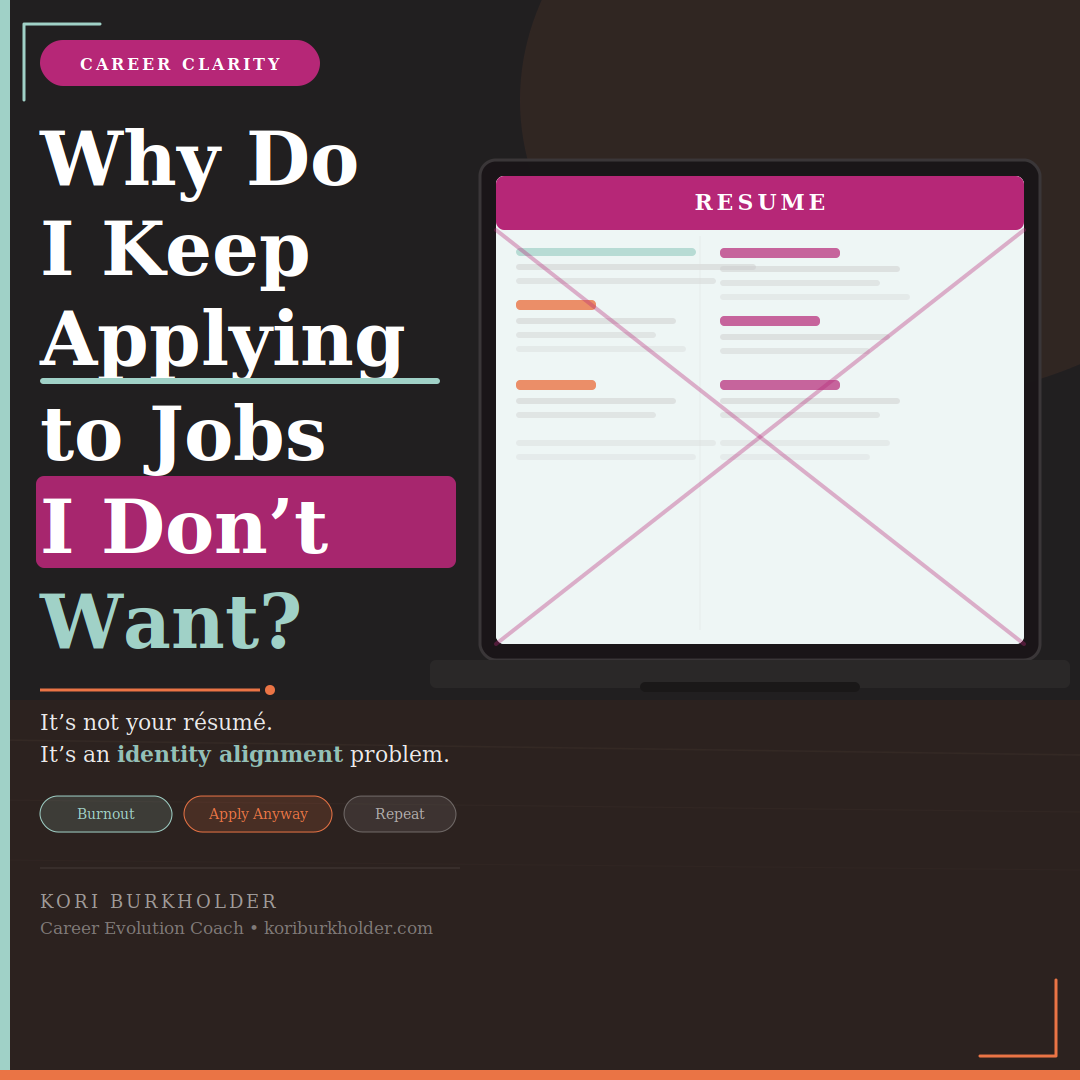
You know the cycle.
A bad day at work. A frustrating meeting. A quiet Sunday where the dread about Monday creeps in earlier than usual.
You open LinkedIn. You start browsing. You find a role that’s — fine. Similar to what you do now, maybe a slightly better title, possibly a better company. You apply.
And somewhere in the back of your mind, you already know you don’t actually want it.
You apply anyway. Because doing something feels better than doing nothing. Because maybe this one will be different. Because at least you’re moving.
Then you don’t hear back. Or you get to the interview and feel nothing. Or you get the offer and panic, because suddenly it’s real — and it’s not right — and you don’t know how to explain why.
So you stay. Or you start the cycle again.
If this sounds familiar, I want to say something to you directly: this isn’t a discipline problem. It’s not a laziness problem. It’s not even a confidence problem.
You’re caught in what I call the Burnout-Apply-Repeat cycle — and it’s not a personal failing. It’s what happens when you try to solve an identity problem with a job search.
What’s Actually Happening (And Why Effort Alone Won’t Fix It)
Here’s the thing about high-achieving professionals who end up in this cycle: they’re not passive. They’re not avoidant. They’re not waiting to be rescued.
They’re applying. They’re networking. They’re doing everything the career advice playbook says to do.
But the applications feel hollow. The networking conversations lead nowhere. The roles they land feel like a lateral move — same environment, different address.
The reason this keeps happening isn’t what most people think.
It’s not that the job market is too competitive. It’s not that you need another degree or certification. It’s not that you’re interviewing poorly.
It’s that you’re trying to find a new path without first knowing who you are now.
Your values have shifted. Your standards have risen. The kind of work that used to energize you no longer does — and you know it. But without a clear picture of who you’re becoming, you default to what’s familiar. You apply to roles that match your history, not your trajectory. Roles you can do in your sleep. Roles that look right on paper but feel wrong the moment you imagine actually doing them.
That gap — between who you’ve become and where you’re applying — is what’s creating the cycle.
The Real Cost of Staying in the Cycle
I want to be honest with you about what staying here costs.
It’s not just time. It’s not just wasted applications. The real cost is subtler and more erosive than that.
Every role you apply to that you don’t actually want teaches you something about yourself. It teaches you that misalignment is normal. That “good enough” is what you deserve. That maybe the work that truly excites you isn’t available — or isn’t realistic — or is something you’ll figure out someday when things calm down.
And the longer you stay in that story, the harder it becomes to trust yourself when a genuinely aligned opportunity appears.
You start second-guessing your instincts. You mistake clarity for naivety. You convince yourself that the practical, sensible move is the responsible one — even when every part of you knows it’s not right.
That’s not strategic caution. That’s slow erosion of your own self-trust.
What This Cycle Is Telling You
Here’s what I’ve learned after a decade of coaching professionals through career pivots: the Burnout-Apply-Repeat cycle isn’t a sign that something is wrong with you. It’s a signal that something is ready to shift.
You’re not stuck because you lack drive or direction. You’re stuck because you’ve outgrown a chapter — and you haven’t yet named what the next one is.
And until you do, every job search is just rearranging furniture in a house you’ve already decided to leave.
The question isn’t “how do I find a better job?” The question is: Who am I now — and what does that person actually need next?
That’s a fundamentally different starting point. And it produces fundamentally different results.
Why Applying Harder Doesn’t Work
When high-achieving professionals feel stuck, the instinct is to do more.
Apply to more roles. Reach out to more people. Rewrite the résumé again. Optimize the LinkedIn. Take a course. Ask five smart people for advice.
All of that motion creates the feeling of momentum. But motion and momentum are not the same thing.
Motion without direction just exhausts you faster.
What actually breaks the cycle isn’t more applications — it’s a recalibrated Clarity Signal™.
Your Clarity Signal is your internal decision filter. It’s the combination of your current values, your evolved non-negotiables, your energy patterns, and your honest assessment of what you will and will not tolerate anymore.
When that signal is weak or undefined, every role looks simultaneously possible and unsatisfying. You can’t eliminate anything, so you keep the field wide open. You apply to things you don’t want because at least they’re options.
When your Clarity Signal is strong, something shifts entirely. The wrong options lose charge. You stop asking what can I do? and start asking what aligns with who I am now? You don’t need to consider everything. You have permission to eliminate.
Clarity isn’t about narrowing your options. It’s about redefining the person who’s choosing.
The Part I Need to Say Directly
Not everyone who recognizes themselves in this cycle is ready for what it takes to break it.
Some people want the relief of being seen without the discomfort of actually changing. They want clarity as a concept without clarity as a commitment. They want a better job without the honest reckoning that comes before it.
That’s okay — but that’s not who I do my best work with.
The professionals I work with are done circling. They’ve felt the pull of this pattern long enough. They know that another six months of the same approach is going to produce the same result. They’re ready to do the identity work, follow a structured plan, and take action between sessions — not just in them.
They don’t need to be motivated. They need a map.
They’re not asking “do you think I can do this?” They’re asking “what’s the most strategic path, and how do I execute it without losing myself in the process?”
If that’s where you are, we’re going to work well together.
If you’re still deciding whether you’re ready to move — that’s okay too. But this program won’t be the right fit yet.
What the Path Forward Actually Looks Like
Breaking the Burnout-Apply-Repeat cycle isn’t complicated, but it does require doing things in the right order.
First, you recalibrate your Clarity Signal. Not from a list of job titles, not from what sounds impressive, not from what your network is doing. From your actual values, your hard-won non-negotiables, your evolved standards. You define who you are now — and that definition becomes the filter for every decision that follows.
Then, you build what I call Strategic Regulation™. This is the ability to make high-stakes career decisions from alignment rather than fear or urgency. Because once you have clarity, fear shows up — what if I choose wrong, what if I miss something, what if this doesn’t work — and without regulation, that fear sends you straight back to the familiar roles you’ve already outgrown. Regulation is what keeps you moving forward anyway.
Finally, you translate your evolved identity into positioning. Not a polished résumé. Not a keyword-optimized LinkedIn. A coherent narrative that connects who you’ve been with who you’re becoming — clearly, confidently, and without apology. So that when you walk into an interview or a networking conversation, you’re not explaining a pivot. You’re articulating an evolution.
That sequence — identity, regulation, positioning — is what creates momentum that actually holds.
What Clients Say on the Other Side
Kristen spent a decade in reality television. Always on call, always behind, no room to breathe. She thought she needed a total reinvention. What she actually needed was to recalibrate her Clarity Signal — to name her real non-negotiables around time, culture, and creative fulfillment. Once she did, she didn’t reinvent herself. She realigned. She landed a role that honored her boundaries and reignited her passion for hosting. She’s now hosting live for Amazon.
Katherine was offered a promotion in advertising — the sensible, logical next step. The aligned version of her declined it. Not impulsively. Strategically. She pivoted into recruiting, and when she walked into interviews, she spoke with complete conviction about why. No over-explaining. No justifying the shift. Just clarity. The roles she wanted responded immediately.
Neither of them needed more applications. They needed a different starting point.
One Question Worth Sitting With
Before you apply to the next role — the next “fine, it could work” option — ask yourself honestly:
Am I applying because this aligns with who I’m becoming — or because doing something feels better than admitting I don’t know yet?
If the honest answer is the second one, that’s not a failure. That’s information.
And it’s exactly the right moment to stop applying and start recalibrating.
Ready to Break the Cycle?
If you’re a high-achieving professional who is done with the Burnout-Apply-Repeat pattern — and you’re ready to do the identity work that actually creates aligned momentum — the next step is a Career Alignment Audit™.
This is a focused, strategic conversation where we assess:
- Where your Clarity Signal has broken down
- What’s keeping you applying to the wrong things
- What a targeted, structured path forward looks like for your specific situation
This call is not for the casually curious. It’s for professionals who are ready to move — and want to move correctly.
Book your Career Alignment Audit™ →
Kori Burkholder is a Career Evolution Coach and the author of Screw the Job Market and Reclaim Your Edge. She helps high-achieving professionals close the gap between who they’ve become and how they’re positioned — so their next career move is strategic, calm, and inevitable. Learn more at kori.fabipaolini.com/.
THIS IS THE CALL TO ACTION
call to action image